
Istanbul first city walls were constructed to protect the acropolis, located where Topkapı Palace is today. The second set was built by the Roman Emperor Septimius Severus in 203 and were outside the Greek walls by some 300 meters.
Among the many monuments for which Istanbul is famous, the centuries-old city walls stand out with their impressive girth and structure. Visitors and residents alike catch a glimpse of them while travelling to and from the airport. City Walls of Istanbul extend for 22 kilometers, stretching from the Sea of Marmara to the Golden Horn and have been breached only twice in their entire history. The first time came in 1204 by the Latin Crusaders who were supposed to be heading toward the Holy Land and again in 1453 by the Ottoman Turks who had been eyeing the city of Constantinople with hungry eyes for a hundred years.
The first City Wall of Istanbul were constructed where Topkapi Palace is today to protect the acropolis. They were about six kilometers long with 27 towers spread throughout. The second set was built by the Roman Emperor Septimius Severus in 203 and placed just outside the Greek walls by some 300 meters. When Constantine the Great decided in 324 AD to make the city his eastern capital, his walls were built some six kilometers further to the west. The famous Golden Gate through which triumphal emperors would enter the city was erected during the reign of Theodosius the Great (r. 378-395) and situated even farther beyond the Constantine’s wall.
The walls built by Emperor Theodosius II between 412 and 413 A.D. were probably in response to the sacking of Rome by the Visigoths in 409. The walls, which are still known as the Theodosian Walls, had three parts – a main wall, a lower front wall and a moat or trench divided in such a way that it could be filled with water. These walls still extend around the area today though much of them have been repaired using modern technology. The walls were seriously damaged in 447 AD as a result of a violent earthquake. During these years, Attila the Hun had been raiding and capturing Byzantine cities in the Balkan areas and even reached the walls of Constantinople, but the great warrior was not equipped to attack walls of this size at that time. The Byzantines were so frightened, however, that they immediately repaired the damaged walls in 448. Around this same date the emperor had a sea wall built for the first time.
The very fact that the walls were so formidable kept many an enemy away, although it didn’t stop Arab armies from trying starting in 672 and 673. While the Arabs had a fleet at their disposal the Byzantines had discovered “Greek fire,” an incendiary liquid that could be shot at the enemy. Its formula is unknown but it worked particularly well against ships. It was during this siege that Eyüp Sultan, the companion of the Prophet Mohammed, died and was buried outside the walls. The Arabs had to retreat, but they returned again in 717 to lay siege to the city. Thanks to disease and the Theodosian Walls, the Arabs were forced to withdraw the following year. Although the dream of taking Constantinople remained in the collective Arab memory, it was not until 1453 that the banner of Islam was planted on the city walls.
Fall of the city
Forces in Europe that were to participate in the Fourth Crusade began to gather in 1199 and part of the men set sail from Venice in 1202 with the remainder sailing in 2003. The original goal of these crusaders was the recapture of Jerusalem, which had been conquered in 1187 by Sultan Salahadin. However, along the way the crusaders became sidetracked by the lure of the riches of Constantinople.
They started to besiege the city in 1203, but were unable to capture it until the following year. The Venetians were able to take the seawalls on the Golden Horn while on the land side crusaders had managed to penetrate the land walls at the palace of the Blanchernae. They were able to hold the city until 1261, when the Byzantines discovered an unguarded gate that allowed them to retake the city.
Of course the fall of Constantinople to the Ottoman Turks is well known and needn’t be repeated here. Suffice to say, Fatih Sultan Mehmed had the walls repaired and strengthened because of the threat of another crusade from Europe. The fall of the legendary city shocked all of Europe and there were calls for another crusade but political differences made it impossible. The most significant change made by the sultan was adding three towers to the four already built at the Golden Gate. That made seven towers, which is how it acquired its present name in Turkish, “Yedikule” or Seven Towers. One of the extra towers was used as a prison to keep ambassadors and high ranking government officials; the deposed sultan, Osman II, was kept there before he was executed in 1622. Another tower contained Fatih Sultan Mehmed’s treasury or perhaps the privy purse would be a better term. He eventually transferred this over to Topkapı Palace when he had a suitable space ready for it.
Small day of judgment
In the aftermath of the 1509 earthquake, known in Istanbul’s history as the “small day of judgment” because it lasted 45 days, 49 destroyed towers were rebuilt under the direction of the chief architect of the time, Ali bin Abdullah, and architects Bali and Mahmut. Some 8,000 workers toiled for a year without stopping according to historical sources. During the reign of Murat IV, Grand Vizier Bayram Pasa in 1635 had the houses that were attached to the walls torn down and whitewashed the walls as they were being repaired. Numerous examples of upkeep and repairs like this can be found up to the reign of Abdulhamit II who accepted the idea that the walls should be torn down in order to modernize the city.
The walls were breached in the 19th century so that trains coming from Europe such as the famed Orient Express could enter and exit the city. Local commuter trains also ran along the same tracks. Later the gates were widened so that automobiles and buses could pass through the walls.
All told there are 123 towers and 36 gates of varying sizes and shapes. The main wall consists of five layers of brick between layers of stone. It is approximately 4.80 meters wide and 11 to 14 meters high. They are three stories each with a passage way inside that was strengthened at 50-74 meter intervals with four, six and eight-cornered towers.
In the 1980s and 90s, the issue of repairing the walls came to the municipality’s agenda. Nationalists pointed out that they weren’t Turkish so it was wrong to spend money on repairs. In fact some talked of tearing the walls down completely. In the end the value of the walls as a tourist attraction won out.
Since then several projects have been carried out and recently it appears the Istanbul Metropolitan Municipality is set to launch a new one for the walls preservation.
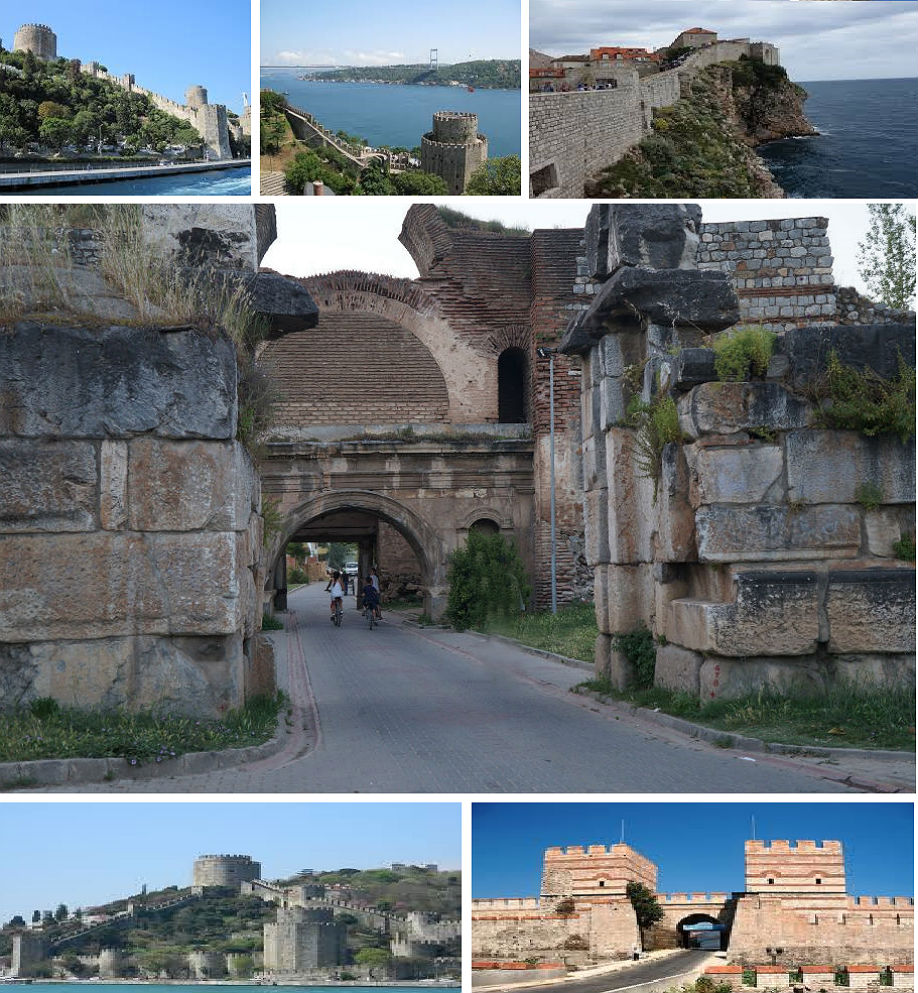
City Walls of Istanbul


We went to the fort on the walls at the sea of Marmara. It was beautiful, amazing, the views of the sea… wow. Also the area in front of the wall is being used as small gardens which was interesting to see. Again this site hase not been developed much so there is little restrictions on where you can go….
Its a long wall with 2-3 layers. A historic place. I was mesmerized by the architecture. It makes me wonder the Constantinople era must be very great.
Given the value of the walls around Istanbul and their importance in safeguarding the residents of Istanbul for centuries, we felt that it was worth the trip to see some of them to appreciate them and to more easily visualize how difficult it was for an invading army to penetrate the walls.
There are many segments of walls still standing…
A great piece of history. Though they're not complete in places this is still a great place to go and see, take pictures and eat with a view.
Just up from Chora Church and the Golden Horn you get some great views of what used to be Constantinople. It is a real climb in some areas so go with someone and dress appropriately.
This place is amazing and quiet. I would recomend it to anyone who has saw all the wanted to see of the main sites. Definitely worth the trek to the suburbs. The fee is pretty minimal.
It is impossible to come to Istambul and not observe the 6 kms. of walls. There important pieces that one should visit and take a good look from very near. There are not only one wall, there are three walls one behind the other. Observing them near you can see why it was difficult to enter Constanttinople.
Very well maintained. They kept free space next to walls. Very impresive. Easy to get with tram and soo worth the visit.
My wife and I walked the entire length of the walls on March 3, 2003. We started at the south end by the Sea of Marmara and ended at the Golden Horn. It took us about half of day. Along the way, we ate lunch, climbed parts of the walls, and saw the Chora Church.
I should have read these reviews more thoroughly. The views from the top are great, after climbing the "stairs" which truly is a stone ladder – we got "help" from a shoe shiner – who then wanted to shine our sandals. He was really good at scamming, so be warned.
It was worth the effort though!