
The Antakya Archaeology Museum is the archaeology museum of Hatay Province, Turkey. It is known for its extensive collection of Roman and Byzantine Era mosaics. The museum is located in Antakya, the main city of Hatay. Construction of the museum started in 1934 on the recommendation of the French archaeologist and antiquities inspector M. Prost. It was completed in 1938 and came under Turkish control in 1939 following Hatay’s unification with Turkey. The museum was opened to the public in 1948 and re-opened in 1975 following renovation and expansion.
Antakya (Antioch) has a rich collection of mosaics dating back to the Roman era in the Second and Third centuries.They have been found in the ancient cities of Daphne, Seleucia Pieria (Samandağ), Antioch and Tarsus. The most famous figures among those depicted by the mosaics are the drunken Dionysos, Orpheus, Dancers, Ariadne Abandoned from Defne (Yakto). Column capitals, a acrificial altar, an cult image, a bas-relief, a fresco and statues date from the Hittites to Roman periods. They were found by excavations in barrows in the plain of Amik. The works in the museum are arranged according to where they were found. Excavations have been carried out at barrows, tells and ruins such as Guneyde, Dehep, Catalhoyuk, Tainat, Al Mina, Ac-ana, Defne-Harbiye and so on. The collection also includes objects from Antakya and its surrounding regions.
The museum’s collection also includes items that reflect the art and culture of the region, from the Paleolithic Age through the present day. The objects are displayed in wall niches. Against the other walls of the room are cases that display a rare coin collection arranged chronologically. The museum’s garden includes Roman period sarcophagi, building stones and water jars. In early 2012, a section of the museum’s collection was digitized as part of an effort to increase museum attendance.
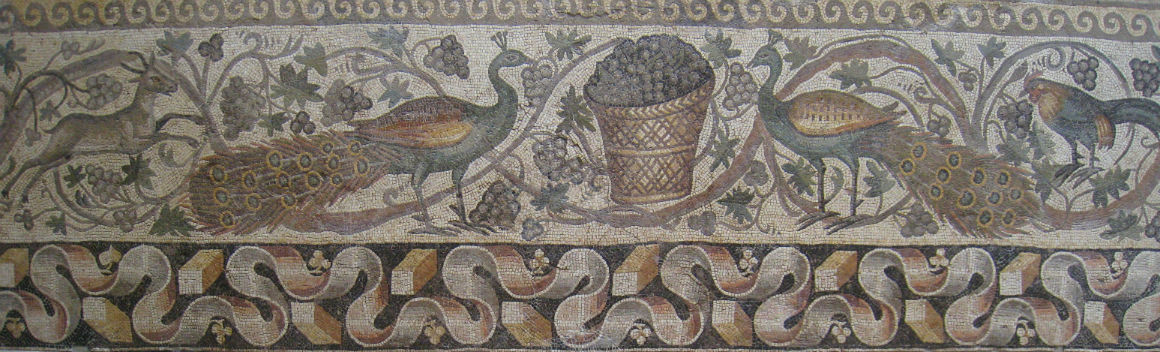
One of the Antioch mosaics located at the Antakya Archaeological Museum
Antioch mosaics
The Antioch mosaics are a grouping of over 300 mosaic floors created around the 3rd century AD, and discovered during archaeological excavations of Antioch between 1932 and 1939 by a consortium of five museums and institutions. About half of the mosaics are housed at the Hatay Archaeology Museum in Antakya, with others currently residing at the Worcester Art Museum, Museum of Fine Arts, Boston, Baltimore Museum of Art, Harvard University and Princeton University Art Museum among others. The mosaics range in design from realistic imagery and scenes, to purely geometric patterns.
Antioch was an ancient city located just outside the modern day city of Antakya, Turkey. During the reign of Hadrian, during the 2nd century, through to the reign of Justinian in the 6th century, mosaic floors were the fashion in the city and its surrounding suburbs. The city thrived until it was destroyed by earthquakes in 526 and 528.
Beginning in 1932, a consortium of museums and institutions sponsored expeditions to the archaeological sites where the city of Antioch once stood. These museums, the Worcester Art Museum, Princeton University, the musée du Louvre, the Baltimore Museum of Art, and Harvard University’s affiliate Dumbarton Oaks, were attempting to uncover great monuments, palaces, and treasures, but were disappointed when most of what was unearthed, under tons of silt, was just the remains of houses, most without any remaining walls. The only surviving part of the majority of the houses was the floors.
The floors the archeologists discovered were covered in intricate mosaics. More than 300 mosaics were found.
In 1939 the expedition ended and the archeologists packed up to leave. They left about half of the unearthed mosaics to the city if Antakya, the modern day city located at Antioch, which subsequently built a museum, the Antakya Archaeological Museum, to house them. The rest of the mosaics were split up amongst the institutions that took part in the dig, and were sent all over the world.[To be transported, large amounts of concrete was poured behind the mosaics to create a stable backing.[ When dividing up the floors, the archeologists, often took apart rooms and sent different parts of the floor to different museums. For an exhibit at the Worcester Art Museum in 2000, mosaics were compiled from Paris, Baltimore, Princeton and Wellesley, to reassemble a single room’s floor. After the expedition left, the pits were filled back in and olive groves were planted over them.
The Antioch mosaics were created at a time and place between distinct artistic styles. They show how the link between artistic styles of ancient Greece and Rome, and the art of early Christianity. The mosaics are incredibly large, with “The Worcester Hunt,” the largest Antioch mosaic in the United States, measuring 20.5 feet (6.26 m) x 23.3 feet (7.11 m).The mosaics range in design from realistic imagery and scenes, to purely geometric patterns. It is believed that the mosaics were created by mosaic specialists.
The Tessera for the mosaics is both white and colored marble as well as white and colored limestone.
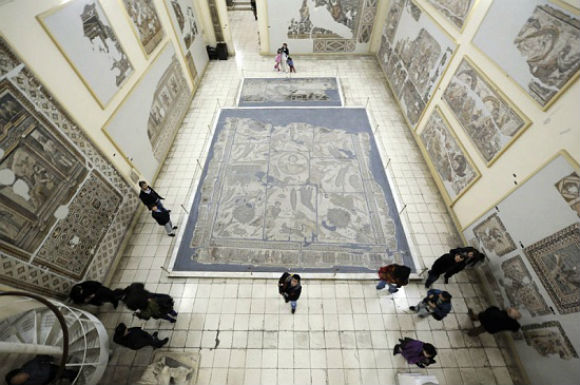
Hunt Mosaic, named for the central figure. Fifth century AD, Yakto village near Daphne, Antakya Museum, inv. 1016. In the center is a woman personifying Megalopsychia (“Greatness of Soul”). Around the central medallion are hunting scenes involving Greek heroes like Adonis and Narcissus. The most significant aspect of this remarkable mosaic is the border, which depicts a “day in the life” of fifth-century Antioch and Daphne and shows several buildings that are now lost. The entire top portion is unfortunately lost, but the three sides that remain mostly intact provide a guided tour from ancient Antioch to Daphne (or vice versa).
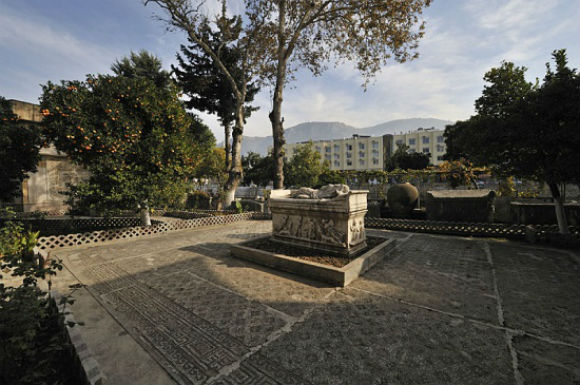
Museum garden, with mosaics and a sarcophagus.
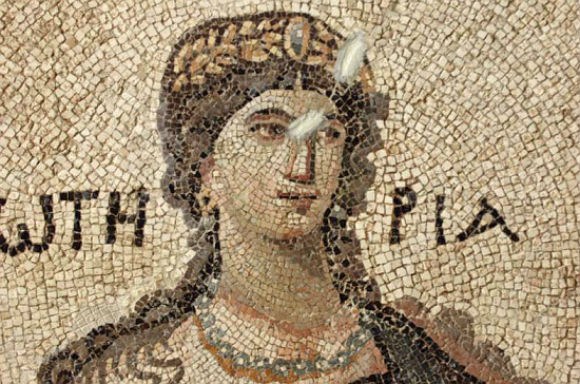
Detail of mosaic from the floor of the 5th-century Bath of Apolausis, a small suburban bath uncovered in the Antioch excavations on the slopes of Mount Silpios, east of the city. The woman depicted in the middle is Soteria (Salvation) who formed a pair with Apolausis (Enjoyment). Soteria and Apolausis were minor deities who had the power to deliver people from danger and were popularly associated in late antiquity with baths, whose warm waters could give pleasure and soothe pain. Antakya Museum, inv. 977.
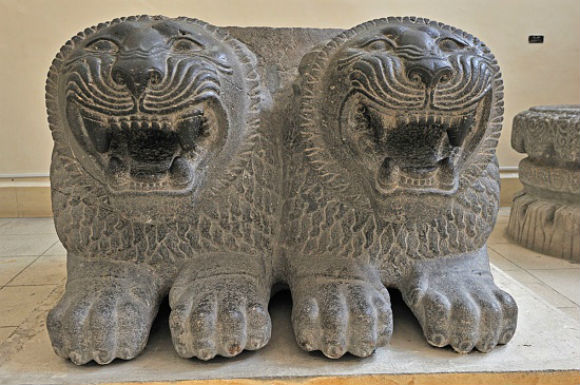
Base of a temple column from 8th century BC Tainat, with fierce lions. Antakya Museum.
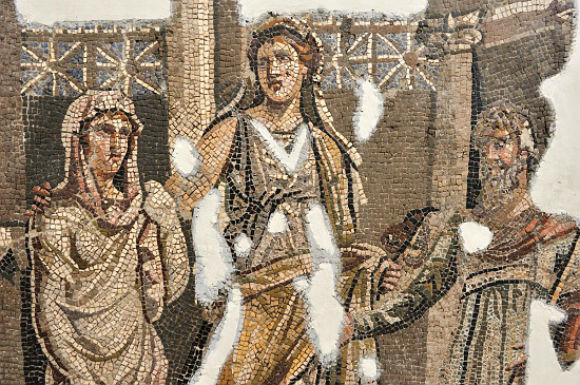
Mosaic of Iphigenia in Aulis from Antioch, late second to early third century AD, Antakya Museum, inv. 961. Iphigeneia is on the left in white and her mother looks at her in grief. On the right (not shown) is Agamemnon, extending his right hand. In Greek mythology, Iphigeneia was the eldest daughter of Agamemnon, king of Mycenae, and Clytemnestra. Her father had to sacrifice her to the goddess Artemis in order for her to stop detaining the Achaean fleet at Aulis and proceed on its way to the siege of Troy. Iphigeneia was a key figure in several Greek tragedies.
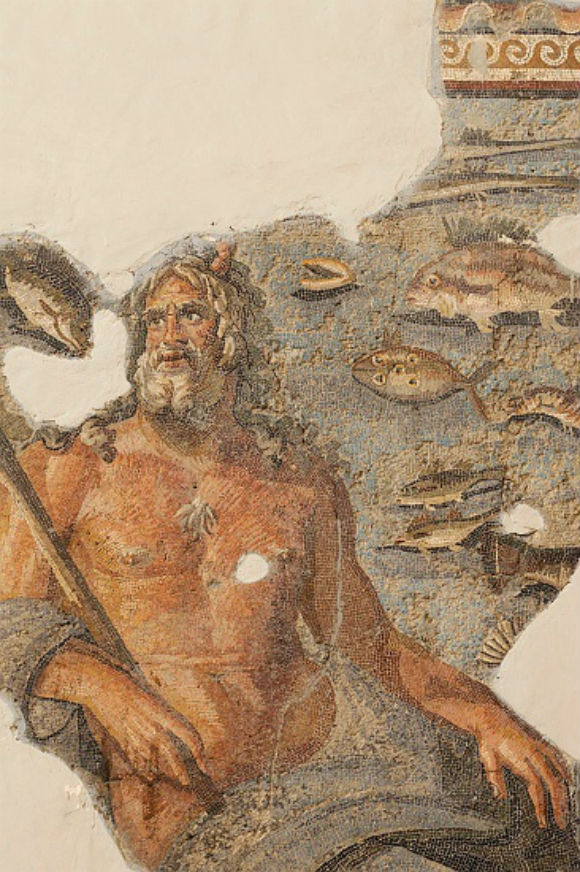
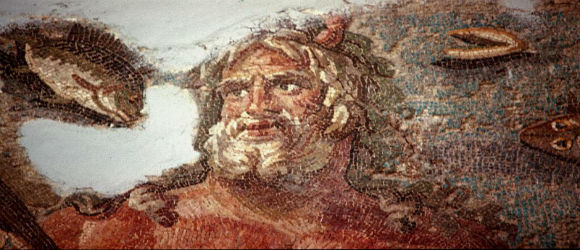
Oceanus Mosaic
Antakya Archeology Museum, Antioch,

Not a big museum and quite old with AC uneven. Some funny mosaics though in the 2nd room and a nice view on top of the 3rd room.
Go early, because you'll want to spend the better part of day here.
While the museum may not be as large as the ones in Istanbul, there is an authentic feel about it. The mosaics and sarcophagus were so interesting and just plain beautiful. To get a feel of how much this region has changed nationalities is evident with all of the relics. Well worth the visit.
Wonderful mosaics and statutes to get an up close view.
The museum is at the downtown and on the banks of Asi (Orontes) river. If you wish to imagine the wealth and luxury of this ancient city in centuries BC, please visit this private website to see the mosaic decorations of the excavated houses and not to miss the visit to the museum:
http://www.pbase.com/dosseman/antakya_museum&page=all
A must see place if you visit Antakya, used to called Antioch in the roman empire. The mosaics are so amazing, however if you travel without guide, you need to get detail information about the mosaics first as the museum you hardly find detailed informations inside the museum.
İ had great expectations about mosaics but i am disappointed. Mosaics are beautiful and fascinating but they are not protected very well. İ couldn't find any barcovision and there is no any place where having rest. But still i believe it has potantial about the future of the mosaics and perception of the museum. And i have good news for…
Antakya has an incrediblly important place in the acient roman history and the museum is supposed to show the most beautiful mozaiks that built in the acient roman history, howver the museum is so unsufficient showing them, no lingual assistance, no books or hardly find a giftshop inside the museum.
Regardless of theses, it is till worth take a tour…
Incredible mosaics as well as artifacts from Hittites to Romans. The Antakya sarcophagus was my favorite.
come and see antakya archaeological museum. you'll like.