
The most attractive edifice on the Curetes Street is the temple dedicated to the Emperor Hadrian. The Emperor came to Ephesus several times. And at one of these times was built the big temple to the north of the Council Church called the Olypeion and at another the Temple of Hadrian.
This temple has gained a rightful fame through the rich workmanship on its facade. In front, two columns with Corinthian capitals in the middle and two angular piers also with Corinthian capitals at the sides supported a semicircular pediment of Syrian type. On the keystone of the pediment there is a bust of Tyche, the goddess of the city, wearing a crown on her head. The lintel of the door behind the columns is richly decorated with classical rows of egg and dart moldings.
On the front of the upper lintel there is a relief of Medusa in the shape of a young girl among acanthus leaves. In the pronaos the frieze on the upper lintel of the door is a copy; the original is on display in the Ephesus Museum. The frieze consisted of four parts. On the first three parts from the left were depicted gods and goddesses and the myth of Androclus, the founder of Ephesus, hunting the boar; gods and Amazons and Amazons and the procession of Dionysus.
The subject of the fourth part of the frieze is different. Here are shown side by side from the left Athena,Selena, a man, Apollo, a woman, Androclus, Hercules, Emperor Theodosius, Artemis the wife and son of Theodosius, and Athena. The inner part of the temple was very simple. As Roman religious buildings were more structures which were not entered their outer parts were constructed particularly ostentatiously.
As understood from the inscription on the architrave the edifice was dedicated to the Emperor Hadrian in 138 AD. Statue bases with inscriptions in front of the temple belonged to the bronze statues of Diocletian, Maximian, Constantius Chlorus and Qalerius who were emperors at the same time. The statues of the same emperors stood in front of the fountain near the Memmius Monument also.
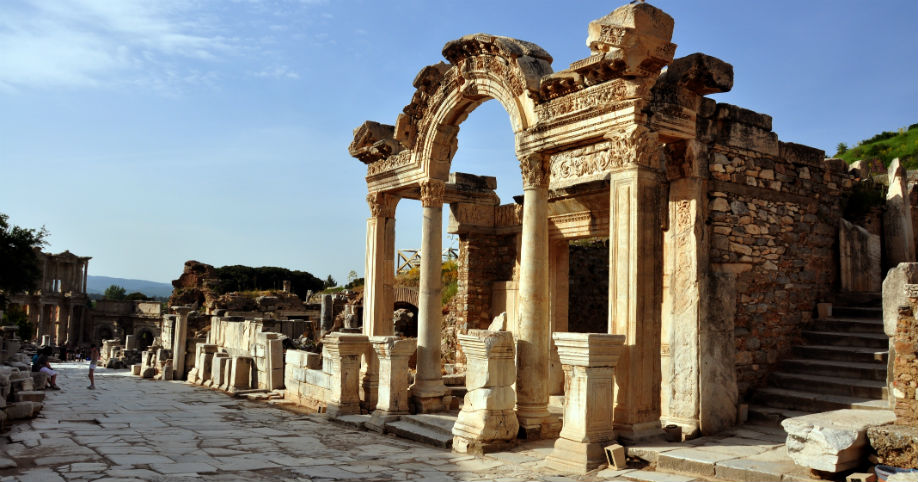
Temple of Hadrian, Ephesus


Seeing such strong evidence of the Cult of the Emperor was really interesting so far from both Rome and Istanbul.
well protected ancient site…You can feel yourself inside of history…
The Temple of Hadrian is one of the main attractions to be seen at Ephesus. Two arches one in front supported on four columns and other interior arch carry the friezes of the goddess Fortuna and Medusa respectively. A series of friezes on the wall on both side of relief of Medusa depict the establishment story of Ephesus.
Seeing this reconstructed temple only requires a little imagination to bring you back to what this ancient city must have looked like. It is a beautiful example of the architecture, and they provide signage which gives more information. Be sure to look at it from all angles as it can't help but impress you.
And then go to museum to better understand how the dimensions of the temple
More like a statue than a temple – but surrounded by water and pretty scenery.
This is one of the attractions where you need to know something about it for it to be meaningful. Be sure to have a look at your guidebook or listen to a guide for this one.
Temple of Hadrian
Temple of Hadrian, Ephesus
Structural Research
The building which is generally referred to as the Temple of Hadrian on the Curetes Street is – not only due to the fact that it was reconstructed in 1957/1958 – one of the most well-known monuments of Ephesos. Since its discovery more than 50 years have passed, although a systematic investigation, and publication of the architectural findings have not yet occurred. Questions of chronology, function and details of reconstruction have for this reason been frequently and controversially discussed in the scholarship, but not ultimately resolved.
It is therefore the goal of the project carried out by the OeAI (FWF-Project no. P-20947-G02) to present a comprehensive investigation of the building in the form of a monograph. In addition to the presentation of the architectural findings and questions relating to the building, for example its architectural decoration, issues of function and the history of usage of the Temple of Hadrian will form the focus of the project. Furthermore, the integration of the monument into an overarching context, for example the relationship with other Ephesian cults or its position within the architectural history of Asia Minor, is also of primary significance.
Methods
For the investigation of the architectural history of the Temple of Hadrian, first of all the building itself has to be evaluated as a source of information. For this reason, a detailed structural recording has been carried out for the first time, whereby modern 3-D recording processes have been preferred, for reasons of time and efficiency, in contrast to traditional measurements taken by hand. In summer 2009, the quarrystone wall in the interior of the building, as well as the immediately adjacent structures, were recorded using a phase comparator scanner (Z+F IMAGER 5006i). In addition, all architectural elements of marble were documented by means of a 3-D structured light scanner, work which was carried out in cooperation with Breuckmann GmbH (Meersburg, D). Based on these results, an analysis of the building history and the relationship to the surrounding structures could be made. The facts which resulted from this analysis constitute the foundation for any future statements concerning the function and history of usage of the building.
An evaluation of the building inscription equally enters into the total analysis, as does an investigation of the architectural decoration, here understood not only as the architectural ornament, but also the relief frieze in the pronaos. All of these elements are to be viewed in close connection with the function of the building. Furthermore, for a comprehensive understanding, it is also necessary to place the Temple of Hadrian in its historical context, and for this reason urbanistic aspects, as well as aspects of the history of religion, enter into the investigation.
In addition to an extensive archaeological study of the Temple of Hadrian, a stated goal of the project is also to investigate scientifically the reconstruction of the building. Within the framework of the project, the structural elements of the modern reconstruction will be taken into account by means of a documentation of damage.
Results
The building, which is integrated into the so-called Varius Baths, conforms in its transverse rectangular groundplan to a tetrastyle prostyle building possessing two columns as well as two pilasters in the extension of the antae.
The excavator Franz Miltner initially identified the building – presumably in accordance with the building inscription – as the neocorate temple for Emperor Hadrian mentioned in literary sources. Michael Wörrle contradicted this interpretation, as he was able to date the inscription on prosopographical grounds to the year 117/118 A.D., therefore more than ten years before the construction of the neocorate temple. Similar circumstances apply to the proposal of Ulrike Outschar, who viewed the Temple of Hadrian as a cult building for the deified Antinoos: Antinoos did not die until 130 A.D., therefore years after the construction of the building. The question regarding the interpretation of the monument, furthermore, was obscured by the relief representations, which have frequently been connected to a renovation in the 4th century A.D. based on art historical grounds; it has even been often proposed that the Temple of Hadrian represents a recombination of individual architectural elements which originally came from a variety of different buildings.
The fact that the building preserved its significance up until Late Antiquity is demonstrated by the statue bases of the Tetrarchs Diocletian, Constantius Chlorus and Galerius erected in front of the building. The fourth base was later replaced by Theodosius I with a statue base of his father, in the course of a redevelopment of the Curetes Street.
The current results regarding the building’s history have revealed that the previous statements need to be revised in a number of significant points: the Temple of Hadrian possesses connections to the surrounding bathing complex, the ›Varius Baths‹, and was therefore constructed at the same time as that complex on the site where it is located today. In addition, the eastern section of the pronaos was never subjected to a restoration. Its relief representations are therefore not to be dated to the 4th century A.D., but instead belong to the Hadrianic period; this is a remarkable result not only for the architecture of the Temple of Hadrian but also for research into relief sculpture from Asia Minor in general.
The clarification of these questions concerning the history of the structure therefore not only fulfills a long-term scientific need regarding the monument itself; from these answers, far-reaching ramifications for our understanding of Ephesian urban and cultic history, as well as for the history of art, architecture, and religion throughout Asia Minor are to be expected.
The Temple of Hadrian is at Ephesus. The friezes of the goddess Fortuna and Medusa are displayed on the wall showing the how Ephesus came to be. It starts with the battle between Hercules and Thesus and Amazon gods. Goes on to show Emperor Theodosius and his family surrounded by Greek gods and other mythological and historical representations.