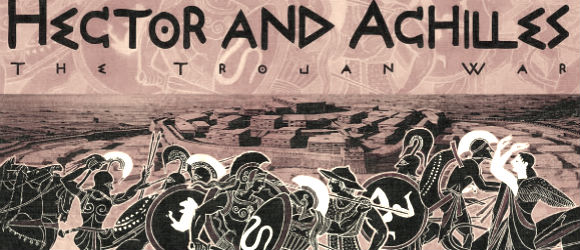
The Classical legends of the Trojan War developed continuously throughout Greek and Latin literature. In Homer’s Iliad and Odyssey, the earliest literary evidence available, the chief stories have already taken shape, and individual themes were elaborated later, especially in Greek drama. The story of the Trojan origin, through Aeneas, of Rome helped to inspire Roman interest; Book II of Virgil’s Aeneid contains the best-known account of the sack of Troy. Finally there are the pseudo-chronicles that go under the names of Dictys Cretensis and Dares Phrygius.
The Trojan War fought between the Greeks and Troy originated in the following manner. King Priam of Troy was wealthy and powerful; by his wife Hecuba and by concubines he had 50 sons and 12 daughters. But his son Paris was invited to judge which of the goddesses Aphrodite, Hera, and Athena was entitled to receive the golden apple marked by the goddess Eris (Discord) “for the most beautiful.” Aphrodite promised Paris the most beautiful woman in the world: he therefore awarded her the apple and went to Greece, where he won the love of, and eloped with, Helen, wife of Menelaus, the king of Sparta.
To recover Helen, the Greeks launched a great expedition under the overall command of Menelaus’s brother, Agamemnon, king of Argos or Mycenae. The Trojans refused to return Helen. Small towns in or near the Troad were sacked by the Greeks, but Troy, assisted by allies from Asia Minor and Thrace, withstood a Greek siege for 10 years. The gods also took sides, notably Hera, Athena, and Poseidon for the Greeks, and Aphrodite (who had a son, Aeneas, by the Trojan Anchises, grandson of Assaracus), Apollo, and Ares for the Trojans. The Iliad, which is set in the 10th year of the war, tells of the quarrel between Agamemnon and Achilles, who was the finest Greek warrior, and the consequent deaths in battle of (among others) Achilles’ friend Patroclus and Priam’s eldest son, Hector.
After Hector’s death the Trojans were joined by two exotic allies, Penthesilea, queen of the Amazons, and Memnon, king of the Ethiopians and son of the dawn-goddess Eos. Achilles killed both of these, but Paris then managed to kill Achilles with an arrow. Before they could take Troy, the Greeks had to steal from the citadel the wooden image of Pallas Athena (the Palladium) and fetch the arrows of Heracles and the sick archer Philoctetes from Lemnos and Achilles’ son Neoptolemus (Pyrrhus) from Skyros; Odysseus and Diomedes achieved all these. Finally, with Athena’s help, Epeius built a huge wooden horse. Several Greek warriors hid inside it; the rest of the Greek army sailed away to Tenedos, a nearby island, pretending to abandon the siege. Despite the warnings of Priam’s daughter Cassandra, the Trojans were persuaded by Sinon, a Greek who feigned desertion, to take the horse inside the walls of Troy as an offering to Athena; the priest Laocoon, who tried to have the horse destroyed, was killed by sea-serpents. At night the Greek fleet returned, and the Greeks from the horse opened the gates of Troy. In the total sack that followed, Priam and his remaining sons were slaughtered; the Trojan women passed into slavery in various cities of Greece. The adventurous homeward voyages of the Greek leaders were told in two epics, the Returns (Nostoi; lost) and Homer’s Odyssey.
The few Trojan survivors included Aeneas, whose descendants continued to rule the Trojans; later tradition took Aeneas’s Trojans to Italy as the ancestors of the Romans.
Medieval legends
Medieval European writers, unacquainted with Homer firsthand, found in the Troy legend a rich source of heroic and romantic storytelling and a convenient framework into which to fit their own courtly and chivalric ideals. The chief sources for medieval versions of the story were fictitious eyewitness accounts of the Trojan War by Dictys Cretensis and Dares Phrygius. The key work in the medieval exploitation of the Trojan theme was a French romance, the Roman de Troie (1154–60), by Benoît de Sainte-Maure.
Later medieval writers used the Roman de Troie until it was superseded by a Latin prose account, the Historia destructionis Troiae (c. 1287; “History of the Destruction of Troy”), by Guido delle Colonne. The French author Raoul Le Fèvre’s Recueil des histoires de Troye (1464), an account based on Guido, was translated into English by William Caxton and became the first book to be printed in English as The Recuyell of the Histories of Troye (c. 1474). See also Trojan War.
Trojan War,